Your First Research Poster
IEEE HealthCom 2026 · Young Researcher Symposium
One student, one poster. We walk the whole AI-era research pipeline — from question to a real conference submission — with every tool you've already learned in Classes 1–10.
Merit Point Academy · 科研海报冲刺 · press S notes · → next · 💬 to comment
A real IEEE conference is calling for your poster
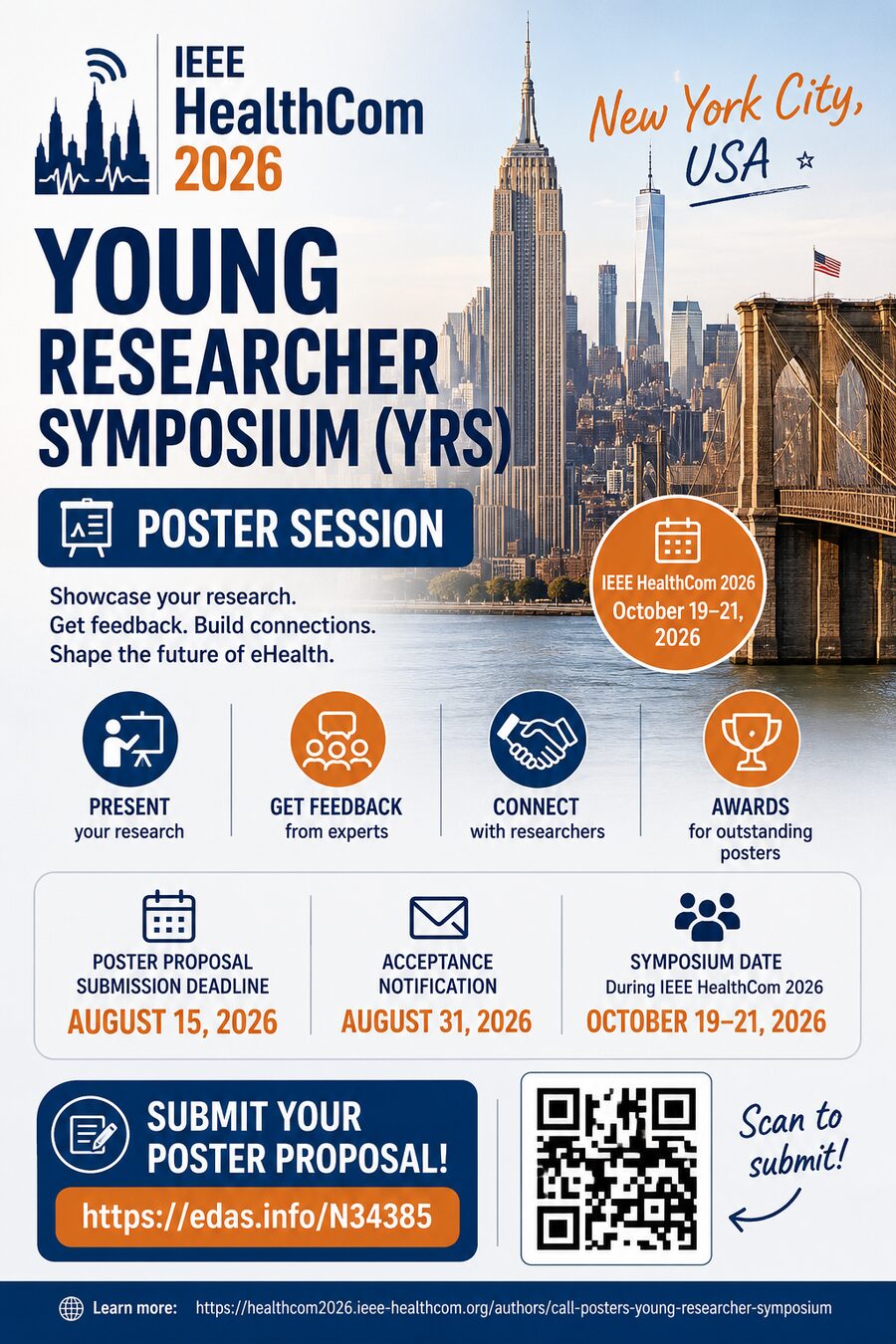
IEEE HealthCom 2026 · Young Researcher Symposium (YRS)
A poster session at a real IEEE conference on eHealth — held in New York City, October 19–21, 2026. Young researchers present a poster, get feedback from experts, connect with researchers, and compete for outstanding-poster awards.
The three official dates 官方时间线
Poster proposal deadline · Aug 15, 2026Acceptance notification · Aug 31, 2026Symposium · Oct 19–21, 2026
Submit at edas.info/N34385: an extended abstract, up to 2 pages — including figures, tables AND references — in the IEEE conference template · first author must be a high-school/undergrad student · at least one faculty mentor as co-author · accepted posters are expected to be presented in person · details: healthcom2026.ieee-healthcom.org → Authors → Call for Posters (YRS)
The goal is the process, not perfection
This project's purpose is to walk one full lap of the AI-era research workflow — question → literature → data → analysis → poster → presentation — so that "doing research" stops being a mystery and becomes something you have done.
Knowledge is endless 知识学不完
Nobody — not your mentor, not any professor — has "finished" learning. Missing background is normal, not a reason to wait.
The one real requirement
Everything on your draft, you can explain clearly in your own words. That's the whole bar. 只要能把自己 draft 里涉及的部分讲清楚即可。
Don't panic, ask 不着急
Stuck on a concept your poster needs? Shrink the claim, or bring it to your mentor / the class. Both are researcher moves.
One big page that tells one complete story
A research poster is your whole project on a single large page (typically A0 / 36×48 in, portrait), designed so a stranger gets the story in 90 seconds — then talks to you about it.
1 · Header
Title (your question, in plain words), your name, school, program. Big — readable from 3 m away.
2 · Intro & Question
Why this topic matters + your one research question (the input → output → metric recipe from Class 2).
3 · Data
Where the data came from, what one row means, size, license — your Class 7 datasheet, compressed.
4 · Methods
What you did, as a simple pipeline diagram: clean → split → model/analyze (Classes 8–10). Pictures beat paragraphs.
5 · Results
1–3 honest charts (Class 9 rules: labeled axes, no lying axes) + the honest numbers (test score, not train score).
6 · Conclusion & Limits
What you found, what it does not prove, what you'd do next. A limitations line makes you MORE credible, not less.
Rule of thumb: ≤ 800 words total on the whole poster · every section skimmable · at least one figure per column · references + QR code in a small footer.
One student, one poster — the checklist
Non-negotiables 硬性要求
✅ One poster per student — your own question, your own data, your own name on it
✅ All six sections present (title → conclusion)
✅ A real dataset you actually analyzed (Classes 7–10 work counts!)
✅ At least one chart you made from real data, axes labeled
✅ Honest numbers: test-set results, limitations stated
✅ You can explain every element on the poster in your own words
Format 规格
📐 A0 portrait (or 36×48 in) — one page, PDF
🔤 Title ≥ 72 pt · headings ≥ 40 pt · body ≥ 24 pt
📊 Figures first: aim for ~40% figures, ≤ 800 words
🎨 2–3 colors max, dark text on light background
🛠 Build in Google Slides / PowerPoint / Canva / LaTeX — set the page size FIRST
📎 Footer: references + a QR code to your project page (Guide 04!)
Every poster section has an AI co-pilot you've already met
| Poster step | AI / tool | Where you learned it |
|---|---|---|
| Sharpen the question | ChatGPT/Claude as question critic (input→output→metric) | Class 2 · Class 4 |
| Related work, 3–5 papers | Elicit · Semantic Scholar · Connected Papers | Class 6 |
| Find & judge a dataset | Kaggle / UCI + the RIGHT checklist + datasheet | Class 7 · Guide 05 |
| Clean + analyze + model | pandas · matplotlib · scikit-learn in Colab, AI assistant beside you | Classes 5, 8, 9, 10 |
| Draft the text (then verify!) | LLM drafts abstract/intro from YOUR results; you fact-check every claim | Class 4 |
| Figures & layout at pro quality | Claude Code: regenerate charts, tune styling, even lay out in LaTeX | Class 10 demo · Guide 06 |
AI may draft. You must own.
✅ Great uses
Brainstorm titles · critique your question · summarize a paper you then skim · explain YOUR error message · draft a section from YOUR real results · polish grammar · suggest chart improvements.
🚫 Never
Invented data or results · citations you never opened (hallucination risk — Class 4!) · numbers on the poster that don't come from your own notebook · text you can't explain when asked.
The ownership test
Before anything goes on the poster, close the chat window and explain it out loud. Can't? Then it's not yours yet — learn it or cut it.
Ten weeks, four milestones
Official dates 官方节点
Proposal due Aug 15 · acceptance Aug 31 · symposium Oct 19–21. Ours are set a day+ earlier — never surf the deadline.
Weekly heartbeat
Every class starts with your 3-minute progress presentation (next slide). Small steps every week beat a heroic final weekend.
If not accepted?
The poster still gets finished, presented in class, and aimed at the next venue — science fairs and other symposia accept the same poster. Zero wasted work.
The progress-presentation ritual
From now until the symposium, every class opens with every student presenting ~3 minutes on their poster's current state. This is not a status check — it's presentation training, the exact skill the poster session tests.
Your 3 minutes · 三句话结构
1️⃣ What changed since last class — show the thing (chart, section, draft screen)
2️⃣ Where I'm stuck — one concrete blocker, asked as a question
3️⃣ Next step — the one thing you'll do before next class
Mentor review timeline 导师评审节奏
📝 Live comments on every progress talk, in class
📄 Written review comments within 48 h of each milestone (proposal, v1, v2)
🎯 Final check pass on your print-ready PDF before it goes to print
What each milestone must contain
| Milestone | Due (11:59 pm ET) | Must contain | Mentor comments by |
|---|---|---|---|
| Proposal draft | Wed Aug 12 | Extended-abstract draft (IEEE template, ≤2 pages incl. figures, tables & references): title · question · dataset · planned analysis | Aug 13 (fast lane!) |
| EDAS submission | Fri Aug 14 | Submitted at edas.info/N34385, mentor listed as co-author · confirmation screenshot | — (official deadline Aug 15) |
| Poster draft v1 | Sun Sep 13 | Full A0 layout, all 6 sections drafted, ≥1 real chart from your data | Sep 16 |
| Poster draft v2 | Sun Sep 27 | Every v1 comment addressed · final figures · practice-talk ready | Sep 30 |
| Final print PDF | Fri Oct 9 | Print-ready A0 PDF · references + QR footer · ownership test passed | Final check Oct 10–12, then print |
Quick check · tap an answer
Your draft uses linear regression, and honestly you're shaky on how gradient descent works inside. The best move is:
The bar is being able to explain what's on YOUR draft at the level you use it: what the method does, why you chose it, what the honest result was. "It fits a line that predicts my Y from my X, and I report the test-set score" is a clear, honest, defensible answer — deeper internals are a bonus you can build with your mentor. Deleting real work, bluffing, or freezing until you know everything are all worse than scoping your claim to what you can defend.
What you need — and where it comes from
From yourself 学生
~3–4 focused hours/week · show up to the ritual every class · submit milestones on time · own every word on your poster.
From your mentor 导师
Topic & dataset triage · written comments within the review windows · practice-talk coaching · final print check. Ask early, ask specifically.
From your family 家长
Protected weekly work time · printing the final A0 poster (~$40–80 at a local print shop) · and the New York question: if accepted, the symposium expects at least one student author to present in person — so talk about the October trip as a family before we submit.
The proposal sprint starts now
☐ Name your dataset and check its license (Guide 05 checklist)
☐ Draft your extended abstract — IEEE template, ≤2 pages including figures, tables & references; start from a 150-word core, then grow it. AI may help draft, you must own every sentence
☐ Submit the proposal draft by Wed Aug 12 → mentor comments within 24 h
☐ Submit on EDAS (edas.info/N34385) by Fri Aug 14
☐ Come to next class ready for your first 3-minute progress talk
Assignments & due dates · academic.hopeembark.org/assignments · 有问题随时在评论区 💬 或课上提问